
We are currently witnessing a genuine energy transformation. Increasing uncertainty in conventional fuel markets, as well as concern for our shared environment, are now pointing the way towards sourcing energy from inexhaustible natural resources such as the sun, wind, or water. After decades of dominance, fossil fuels are giving way to environmentally friendly solutions. The world is turning to RES, that is, renewable energy sources. Experts agree – a revolution in the energy system awaits us soon, and hydrogen will become one of the most important sources of energy...
Changes are shaping a new reality
Carbon dioxide emissions into the atmosphere and the growing presence of greenhouse gases in our air are making our future uncertain. If we do not halt the production of toxic gases, environmental changes will become a real threat. Therefore, intensive work is underway to find alternative energy sources in order to reduce carbon dioxide emissions into the atmosphere.
New ecological fuels will replace fossil ones, just as modern navigation systems have replaced traditional maps. One increasingly popular solution is energy generated from hydrogen. At present, the driving force behind these changes is concern for our shared environment.
Hydrogen has been spoken of for years as the fuel of the future
Hydrogen is the most common chemical element in the universe and on our planet. It is most often found in the form of various chemical compounds. In its simplest form (H2), it is a substance with a higher energy potential than the fossil fuels we know, in relation to unit mass.
Hydrogen has many advantages. It is characterised by lightness, ease of storage, and high energy density. Additionally, it does not cause direct emissions of pollutants or greenhouse gases.
However, in practice, it is necessary to improve efficiency and reduce costs, because firstly, its production is energy-intensive, and when mixed with air it forms an extremely explosive mixture, known as oxyhydrogen gas. Secondly, transport and storage require precautions.
Hydrogen can be obtained from low- or zero-emission sources, and the product of combustion is H2O. Therefore, it is undoubtedly an environmentally friendly fuel.
Surpluses of electricity produced from RES can be used to produce hydrogen, which can be stored and used at the appropriate moment to generate electricity and heat. It can be produced both from fossil resources and through the process of water electrolysis. The release of energy from such fuel itself will not result in the production of harmful exhaust gases. This means that hydrogen-powered vehicles will be zero-emission.
How does a hydrogen engine work and is the idea cost-effective?
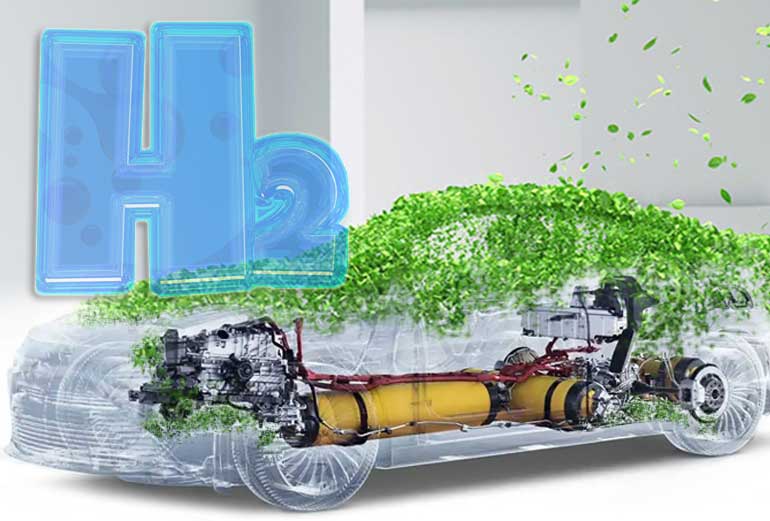
A hydrogen car is somewhat of a chemical power plant, in which the role of the power plant is played by fuel cells. The set of cells continuously generates electricity, which powers the electric motor. This is a completely new way of obtaining energy, which works on a different principle than a combustion engine or a battery.
From the tanks containing compressed hydrogen, via pipes, the hydrogen moves to the fuel cells through the anode, which emits electrons. These electrons then travel along wires, producing electricity that powers the vehicle's wheel motors. This is how the car moves forward. At the other end of the cell, these electrons combine with hydrogen and oxygen from the air, and as a result, the only thing emitted by the cell is water.
It should be noted, however, that at the current stage of technological development, producing hydrogen, then delivering it to stations, refuelling the car, and converting it back into electricity is expensive.
A great deal of energy must be invested in its production, transport, and infrastructure, while relatively little is recovered during driving; 20% for hydrogen production, 13% for compression for storage, 10% for transport to refuelling points.
In traditional electric vehicles, we lose only 6% in energy production, because electricity does not require compression or extraction. However, it should be added that in the case of battery-based electric vehicles, there is also the production of the batteries themselves and the fact that more energy is obtained from non-renewable energy sources, that is, from burning fossil fuels.
Hydrogen is everywhere, but to obtain it and deliver it to refuelling stations requires a lot of electricity. Depending on the chosen technology, this amounts to several dozen kWh per kilogram of hydrogen, so more energy is needed to produce hydrogen than can later be recovered from it. That is why, at present, the energy produced is more often used to charge batteries than to produce hydrogen. Of course, work is ongoing and soon the balance may shift significantly in favour of hydrogen propulsion.
Today, new hydrogen-powered cars are in fact electric vehicles that draw electricity from fuel cells refuelled with hydrogen. Both electric cars like Tesla and hydrogen cars (Toyota Mirai) are essentially electric vehicles, meaning the electric motor drives the wheels.
The issue of power supply remains problematic. For electric vehicles, the problem lies with the batteries; for hydrogen vehicles, the issue is the losses involved in producing pure hydrogen. The technology is constantly evolving, with many companies investing time and money in their development. Both technologies are better than combustion engines, but neither can yet be called the winner.
Is hydrogen for cars a safe solution?
Simultaneously with work on improving the engine, efforts are being made to ensure the safety of drivers and passengers. The aforementioned Toyota Mirai has successfully passed very rigorous crash tests. The tests even included shooting at hydrogen tanks with firearms, collisions with lorries, as well as deliberately breaching the tank and igniting the escaping hydrogen. In this way, it was proven that burning hydrogen does not endanger the car's passengers and does not damage the vehicle. The lightest element in the universe rises in the form of a narrow column, so the flame does not engulf the passenger cabin, as is the case with ignited petrol. A large amount of compressed hydrogen is needed at very high pressures. Therefore, the tanks are specially reinforced, and filling them takes as long as traditional refuelling.
What do we already have?
In ecological road transport, lorries and large machines powered by hydrogen fuel cells seem to be an excellent solution. Hydrogen tanks weigh significantly less than the batteries needed to store a similar amount of energy, and if necessary, the fuel reserve can be replenished incomparably faster than it would take to charge batteries with a capacity of hundreds of kilowatt-hours.
Meanwhile, the range of vehicles powered by "green" energy is increasing. There are already models available that can cover a distance of around 700 km. Charging on long routes can be combined with providing drivers with time to rest at parking areas adapted for these needs. Powering HGVs with hydrogen on routes spanning thousands of kilometres is a sensible and technically feasible solution.
However, investment is needed in charging stations for transport vehicles powered by RES in logistics centres, main transhipment hubs, and at parking areas along major freight transport routes.
Well-known truck manufacturers such as Daimler Truck, Volvo Trucks, and Hyundai see hydrogen as the fuel of the future. Hyundai has presented a hydrogen-powered lorry named HDC-6 Neptune and the ecological refrigerated trailer HT Nitro ThermoTech. These are vehicles with a truly futuristic appearance, fit for the future.
At this point, however, batteries are still too heavy to be used in long-distance commercial vehicles. Smaller electric lorries are already used in urban traffic, as delivery or municipal vehicles.
It is possible that there will be demand for long-distance coaches powered by hydrogen for intercity and international transport, due to the limitations of electric vehicle batteries. However, battery quality and capacity are constantly improving, so this demand may disappear before we manage to replace the remaining fleet of buses and coaches from combustion to electric.
Meanwhile, on offshore platforms, hydrogen is used on submarines, where hydrogen fuel cells are favoured due to pressure to reduce exhaust emissions, and aircraft manufacturers are announcing their introduction to the market.
Poland and the World
Work is underway worldwide to improve hydrogen technology. A number of countries are effectively developing ways to use it.
Japan intends to use fuel cells and electrolysers on a large scale to power offices and homes. Moreover, every fuel cell car can serve as a home power plant, providing a source of power during a grid outage for up to a week.
China is expanding its hydrogen refuelling infrastructure, and several car manufacturers are currently working on fuel cell vehicles, including Great Wall Motor, which plans to develop hydrogen-powered SUVs.
The European Union wants to build more hydrogen refuelling stations for commercial vehicles. Many questions remain unanswered, for example, how to pay for powering electric vehicles and how to obtain sufficient hydrogen from renewable sources. At the same time, the European Clean Trucking Alliance, established in summer 2020 by major manufacturers and freight forwarders, is calling on the European Commission to stop funding fossil fuels. Instead, it is appealing for investment to be focused on zero-emission technologies.
The United Kingdom is already implementing rational ways of sourcing energy using hydrogen technology. An example is a device launched at a Shell station on the London ring road. It is a water electrolyser that automatically switches on when there is a surplus of green energy in the grid. The hydrogen produced is stored in a tank and then refuelled into customers' cars at the station.
Poland is one of the largest hydrogen producers in Europe, but unfortunately it comes from coal-based technologies. However, there are assurances that hydrogen production will ultimately shift to renewable energy sources. A zero-emission city bus has already been created, developed from scratch in Poland in Świdnik, in cooperation with partners from Europe. NesoBus is an environmentally friendly vehicle powered by green hydrogen, designed for public urban transport. Serial production of this bus is already planned.
On the streets of Polish cities, Toyota has registered hydrogen cars in Poland. The first station for refuelling hydrogen has been established. It is located on Łubinowa Street, on land belonging to Polsat television. The broadcaster has purchased 40 units of the second-generation Toyota Mirai powered by hydrogen fuel cells. The fleet will also include 10 Hyundai Nexo vehicles. It is noted that the hydrogen refuelling station will be one way to utilise surplus energy.
The authorities of MPK Kraków and PKN Orlen have launched their first mobile hydrogen refuelling station in Kraków. The station has been operating since June 2022. Hydrogen from this station powers the fuel cells of a zero-emission bus tested in Kraków's public transport – the Solaris Urbino. One hydrogen refuelling allows for 350 kilometres of emission-free travel.
There are plans for city buses and other vehicles to be able to refuel with hydrogen in more Polish cities in the near future. The first hydrogen stations are also planned to open in Katowice and Poznań in 2023.
What does the future hold?
For hydrogen to contribute to the transition to clean energy, it must be adopted in sectors such as transport, construction, and energy generation. Hydrogen is increasingly mentioned in the context of broadly understood innovative propulsion systems. In the face of depleting oil reserves, the future of the automotive industry depends on alternative ways of powering vehicles. Hydrogen is a very advantageous and universal alternative to oil. It can be produced locally in any country, both in home devices and on an industrial scale.
Will hydrogen become something natural in the future and significantly influence the development of transport and the automotive industry, and in the coming years also the maritime and aviation sectors? Perhaps it will replace natural gas and oil, and over the next several decades it will certainly become a very important energy source.
The very way of driving a hydrogen-powered vehicle will not differ from driving a petrol-powered car. The biggest change will concern the environment, as hydrogen cars do not emit any harmful substances.
It is suggested that countries that base their economies on this solution will become energy self-sufficient. This will be a huge step forward for them, both economically and politically. Return