
GPS tracking in companies is becoming increasingly popular. Entrepreneurs are keen to use GPS trackers to enhance fleet security, improve work organisation, and reduce vehicle operating costs. However, as technology develops, the question arises: how can GPS tracking be implemented in compliance with GDPR and current regulations?
In this article, we provide a step-by-step guide on how to sensibly implement a GPS system in your company so that it complies with the law and builds trust within your team.
List of topics:
Why is GPS tracking in a company subject to GDPR?
Every GPS tracker installed in a company vehicle processes data such as:
- current vehicle location
- route history
- driver working hours
- driving style
Since this information can be linked to a specific employee, it becomes personal data. This means that GPS vehicle tracking must be implemented in accordance with GDPR principles: lawfulness, transparency, data minimisation, and proportionality.
When can a company use a GPS tracker?
GPS tracking in a company is entirely legal if it has a clearly defined purpose. The most common reasons for using GPS are:
- Protection of company assets and vehicles
- Route optimisation and cost reduction
- Monitoring task completion in the field
- Increasing work efficiency
- Improving driver safety
The legal basis is usually the legitimate interest of the employer. However, it should be noted that if GPS operates outside of agreed working hours, employee consent is required.

How to implement GPS tracking in compliance with regulations?
Define the purpose of implementing the GPS system
Before installing a GPS tracker, ask yourself the following questions:
- Why is GPS tracking needed?
- What location data will be necessary?
- To what extent and for how long will the data be stored?
A well-defined purpose is a key foundation for compliance with regulations.
Conduct a risk assessment (DPIA)
DPIA stands for Data Protection Impact Assessment.
It is important to remember that in some cases, the law requires such a data protection impact assessment.
It assesses, among other things:- whether the GPS system may inadvertently infringe on employee privacy
- what data will be collected
- what security measures will be applied
This element increases transparency and protects the company from mistakes.
Inform employees about the monitoring
GDPR requires that employees receive clear and reliable information that the company vehicle is equipped with a GPS tracker. In practice, this means:
- providing an information clause
- updating the work regulations
- explaining how the GPS system operates
Transparency and clarity of information within the company always increase employee trust and comfort. When employees know exactly what data is being collected and for what purpose, they feel more confident and secure in their roles. Clear communication with staff also ensures that monitoring does not cause concern or anxiety, but becomes a natural part of daily work.
Ensure vehicles are properly marked
- Every company car subject to GPS tracking should be appropriately marked.
- Concealing the tracker is illegal and may expose the company to serious consequences
Minimise data and limit monitoring time
Ensure that the GPS system complies with GDPR:
- disable monitoring outside working hours if the vehicle is used privately
- do not collect excessive amounts of detailed data
- store data only for as long as necessary (e.g. 3–12 months)
GPS tracking is intended to support the company, not to surveil employees.
What should be avoided when implementing GPS for companies?
- installing hidden GPS trackers in vehicles
- monitoring employees’ private time without consent
- storing location data for an excessively long period
- using GPS for purposes other than those specified
Such practices may be non-compliant with GDPR principles, so it is important to ensure the entire process is carried out correctly.
Why is GPS tracking in a company worthwhile?
Properly implemented GPS vehicle tracking can bring many benefits to a company. Let us list the most important ones:
- greater vehicle security
- better work organisation
- faster response in emergency situations
- lower fuel and vehicle operating costs
- accurate reports and fleet control
This is a tool that combines convenience, savings, and security, supporting the daily operations of the entire company. Thanks to this solution, both management and employees can work more calmly and efficiently.
Summary
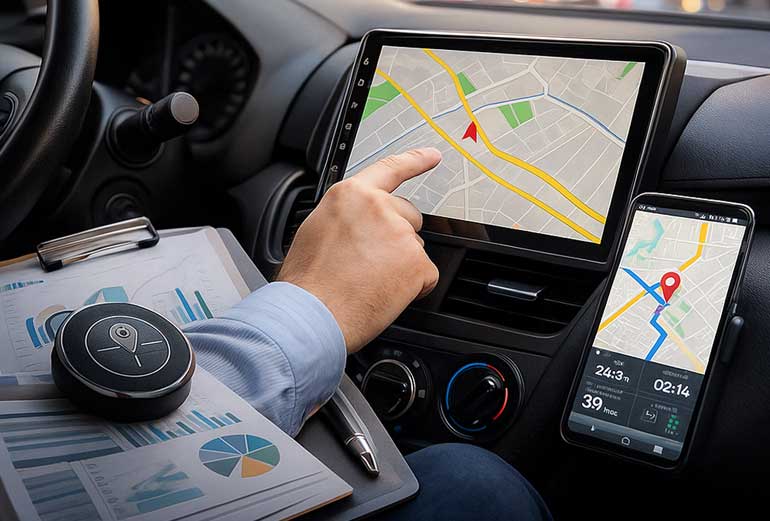
To implement GPS tracking in your company in compliance with regulations, it is essential first to clearly define its purpose, and then to transparently inform employees about how the system operates. The next step is to minimise the scope of location data collected and ensure full transparency throughout the process. It is equally important to choose a GPS-based solution that genuinely meets the real needs of the company, without excessive intrusion into employees’ privacy.
A well-considered and consciously implemented GPS tracking system becomes a tool that significantly increases work efficiency and supports daily fleet management. GPS tracking also allows for better cost control and enables faster and more effective responses to sudden and unforeseen situations. It should also be noted that introducing GPS tracking in a company can significantly improve employee safety.
Thanks to all these advantages, monitoring serves not as a form of supervision, but rather as a practical and well-chosen support that streamlines the organisation of work within the company. Wisely used, a GPS tracker protects the company and improves its operations—all without violating or compromising employee privacy.
MORE INFORMATION
"Does a tracker in a company car violate human rights?"
"How to implement GPS tracking in a company in compliance with GDPR"
RECOMMENDED OTHER ARTICLES ON SIMILAR TOPICS
Why it is worth monitoring drivers