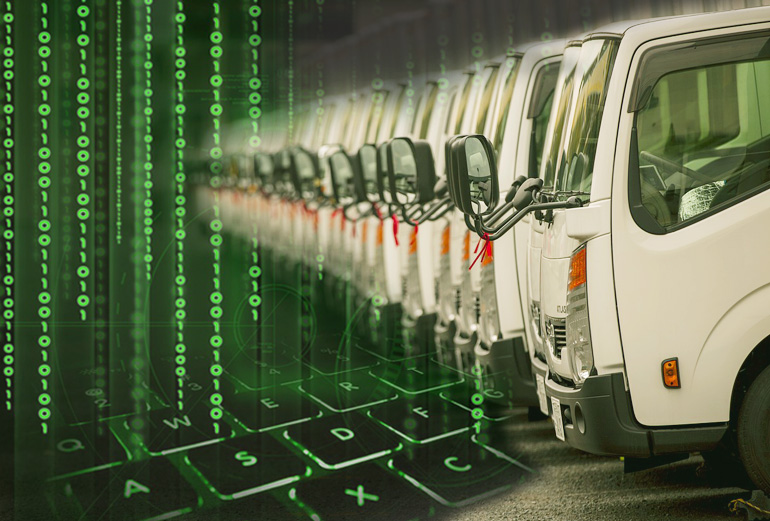

Rapidly rising fuel prices mean that dishonest methods of obtaining fuel are becoming increasingly brazen. According to police statistics, thousands of litres of fuel disappear under unexplained circumstances. The fuel theft phenomenon is thriving. The ingenuity of thieves knows no bounds, and the resulting losses are enormous.
Therefore, tearing your hair out is not enough; it is necessary to start taking effective preventive measures...
But first, a few words about the thieves
It is hardly surprising that thieves can be found everywhere, and for some, stealing fuel is a simple way to gain illegal financial benefit. And it is not just the so-called "fuel mafia". The dishonourable list also includes drivers employed by companies, petrol station staff, and workers operating construction machinery, as they are often the ones committing such thefts.
Individuals with such poor morals can be found among drivers of small delivery vans, minibuses, as well as large HGVs, drivers employed by courier companies, and even train drivers.
Another nuisance are thieves inspired by high fuel prices, who steal under the cover of night and are feared by drivers themselves.
Siphoning off several dozen or even several hundred litres of fuel from a tank is, unfortunately, often seen as a minor social offence.
Human ingenuity knows no bounds, and "opportunity makes the thief"
All it takes is a jerry can and a tube, which allow petrol or diesel to be easily and discreetly siphoned off before anyone realises what has happened, but there are more methods.
Some tanker drivers still use techniques that date back to the communist era. They hang buckets or plastic barrels under each of the tank’s several inlets.
Sometimes, while on the road, a driver will take a shortcut and believe they have "saved" fuel. It is no secret that such "savings" have led to a thriving informal trade in cheaper fuel from HGVs or minibuses at roadside car parks.
Machines and equipment that consume large amounts of fuel, such as construction machinery, are also targeted, as well as, as recent events have shown, military equipment. All it takes is to tap into the fuel system or connect directly to the tank. The contents are drained into jerry cans for personal use or resale.
Fuel is also stolen from passenger cars. The so-called "fuel invoice" theft is well known. Company employees, saving themselves the trip to a client, handle everything by phone and use the "saved" fuel for private purposes.
Fuel theft is also a common occurrence on the railways. Large diesel locomotives with huge fuel tanks are a particular temptation for thieves. Every freight train must perform a so-called "brake test" at the start of its journey. There is a point in the system where a tap can be fitted. If thieves are not caught red-handed, the theft is almost impossible to detect. Unfortunately, the devices indicating fuel reserves in locomotives are very inaccurate.
A particular scourge are thieves feared by HGV and delivery vehicle drivers themselves. These thieves usually operate at night. They siphon fuel from parked vehicles, often damaging tank components or breaking the protective flap to gain access. A popular, albeit notorious, method is to drill into the tank from below with a hand drill and drain the contents into a prepared jerry can. Here, in addition to the loss of fuel, there are further costs associated with repairs.
A vehicle parked in an unguarded car park, in an isolated spot along a route, during a travel break or while waiting for the next load, is an ideal target for such a thief.
Transport and haulage company owners must constantly ensure they are not robbed. When it does happen, losses are often counted in thousands of PLN. Moreover, the problem becomes more serious the larger the fleet the company owner manages.
How to prevent fuel theft
Fuel expenses are among the largest costs incurred by all transport companies. Every business owner regularly monitors fuel prices and consumption, and implements measures to reduce fuel usage and ensure journey safety.
However, even the most carefully planned route by a dispatcher, as well as the vigilance and honesty of the driver, may not be enough to prevent fuel theft. The police always recommend parking in well-lit areas and in such a way that potential thieves have as little access as possible to both the fuel filler cap and the fuel lines.
However, with the increasing audacity of thieves, such preventive measures may not be effective, which is why more advanced solutions are needed.
The contents of the fuel tank can be secured mechanically or electronically. If a vehicle is equipped with advanced security systems, the risk of theft can be largely eliminated.
Here are a few security methods.
A well-known one is the fuel filler lock and security cap. These are the cheapest means of protection against theft, which, although they can be broken by thieves, still provide a barrier.
More effective methods include anti-theft mesh and fuel tank locks.
Another method is monitoring data from the flow meter and the fuel tank. The recommended way to monitor fuel levels is to install a GPS system in the vehicle.
Our solutions At this point, it is worth suggesting a few interesting solutions that will certainly significantly minimise the problem. Such helpful functions are successfully implemented in our "Monitoring-GPS.net" system ("Monitoringu GPS").
- Monitoring fuel level
- Option to connect an external fuel level probe and temperature sensor
- Monitoring fuel consumption and calculating average consumption for each vehicle
- "Fuel refuelling reports" ("Raporty tankowań paliwa")
- Maps showing fuel refuelling locations
- Option to report "Daily fuel consumption" ("Dzienne Zużycie Paliwa") based on sensor readings
Monitoring-GPS.net provides a simple way to monitor fuel consumption in vehicles.
Regardless of the GPS tracker used, you can monitor fuel consumption in tracked vehicles. Of course, it is possible to extend monitoring by using device specifications. The reports sent are clear and comprehensive.
More in this article.
If there are doubts about the time and place of refuelling or fuel loss from the tank, a detailed, tabular view of fuel level records in the tank is needed. This allows you to precisely determine the place and time of refuelling and whether the tank was filled to the top by the driver. The fuel level graph also indicates losses, allowing you to determine whether a sudden drop in fuel occurred while stationary or in motion.
This is how our system deals with the problem.
Each of the following monitoring methods is associated with an effective solution.
Register of fuel invoices
Monitoring fuel level via the CAN bus
Monitoring fuel level via a fuel level probe
Monitoring fuel level via data from the float in the vehicle’s tank
More on this topic here.
By comparing refuelling data and fuel level readings in tanks, it is easy to monitor consumption.
See this article.
For fleet managers, monitoring has the advantage that information is sent to the vehicle owner’s or fleet manager’s mobile device. Data can be received via the application or SMS. This enables immediate response, allowing you to catch the thief "red-handed".
The fuel theft phenomenon in Poland is becoming an increasing problem. It is a major headache for transport and haulage company owners. That is why it is so important to implement effective solutions without delay to minimise company losses as much as possible. Back